Showing posts with label Luke. Show all posts

Friday, 17 January 2014

Thoughts and Summary: The Parable of the Two Builders (Luke 6:46-49)

Thoughts and Summary:  The Parable of the Two Builders (Luke 6:46-49)

By definition, one cannot call Jesus “Lord” without also obeying him. Acknowledging his authority therefore means ordering life according to his aims and commitments- John Carroll



I can think of no story of Jesus that has been more robbed by clichéd, christianese and Sunday-school interpretations than ‘The Parable of the Two Builders’. You probably already know the story. One builds his house on sand, the other on rock, a storm comes along and the house made on sand falls and is ruined. It’s the Christian version of the three little pigs. But a lot is lost on this text (especially to adults) because of the simplistic and basic teaching of “Jesus is the rock on which we should build.” It’s not a bad interpretation; it’s not extremely thorough or nuanced either. Hopefully some of the following insights will bring it home a bit more. I should say, I am looking at Luke’s version that doesn’t talk of 'sand vs rock' but instead 'foundation vs no foundation', but the same principles apply, as will become clear.
It’s not long so it’s worth a read through.

“Why do you call me ‘Lord, Lord,’ and do not do what I tell you? 47 I will show you what someone is like who comes to me, hears my words, and acts on them. 48 That one is like a man building a house, who dug deeply and laid the foundation on rock; when a flood arose, the river burst against that house but could not shake it, because it had been well built. 49 But the one who hears and does not act is like a man who built a house on the ground without a foundation. When the river burst against it, immediately it fell, and great was the ruin of that house.”

Literary context
We should notice where this passage takes place. In Matthews Gospel it takes place just after the ‘Sermon on the Mount’. And in the passage I am looking at, right after the ‘Sermon on the Plain.’ So what has Jesus just taught, that he is so eager to have his followers practice?
Things like:

Love your enemies
Do not judge, Forgive
Be humble, not self righteous
Serve God not money
Do to others as you would have done to you

So Jesus teaches these things and pretty much says “don’t just hear, but practice these things I have taught.” These are the teachings Jesus has in mind.


Rock Bottom

In the Middle East, it is common practice to dig down till you hit bedrock to build the foundations of your house on. This way, when a flood or storm inevitably comes your house will remain stable. Alternatively, you could not dig down and instead build upon the ground (soil/sand). Why would you not dig down? Because in Israel they only build in the summer (it’s hot). Also without modern building tools and vehicles, building takes a long time. So really the decision is between a long hard summer working on a stable house on a sure foundation of rock or a less hard summer with the opposite outcome. The second man doesn’t do the job out of both laziness (he doesn’t want to dig through the deep soil to the rock) and apathy (he knows the risks in his actions, but chooses to ignore them).
Anyway, winter comes, river breaks, house fails, contestant #2 loses. Jesus uses this parable to call for a response to his words. It’s not enough to just hear Jesus’ words, but they also need to be practiced. The Second man in the parable was presented by Jesus as someone who heard but didn’t practice. The consequences were disastrous. The one who has taken the time to build his house on a foundation is the one who has listened to Jesus’ teachings and follows the path of wisdom, while the other hears but ignores thus follows the path of folly (proverbial wisdom). One life brings fruit, the other destruction.

This parable is about me (and probably you).

The man who built his house on rock is presented as the one who responded to Jesus and acted in accordance with his teachings. It would be easy to say “well, obviously the one who is hearing and not doing is not a Christian.” But not so. At the start of the parable, Jesus comments “Why do you call me ‘Lord, Lord’ and do not do what I tell you?” This parable is aimed at people who have heard Jesus’ message, may have even responded to it -exclaiming “Lord, Lord” yet don’t practice the things Jesus commands. Joel Green notes on this that “In this instance, ‘Lord’ is a term of great respect; those who use it would thus be designating Jesus as their patron, the one to whom they owe allegiance.” Well maybe then this is aimed at the Pharisees? Probably not though. At this stage, as Joel Green notes, Lk 6:1-11 makes it highly unlikely that the Pharisees would be addressing Jesus as Lord.
 I can’t help but feel as though this is aimed at none other than me. Another, hypocritical, judgemental, dogmatic Christian who says “yes!” but in my actions I say “Sort of/no!” The ECB notes “Jesus’ emphasis on hearing and also acting on his teaching reinforces the observation that this ethic is not passive: one must do it.”

Additional Points

·         The storm hits both houses. Christians do not have divine protection from trails in life, rather are called to trust in something bigger- a stronger foundation, and to persevere.

·         Following on this what is the storm even meant to represent? Trails in life or perhaps judgement (eschatological)?

Thursday, 9 January 2014

Thoughts and Summary: The Pharisee and the Tax Collector at the temple (Luke 18:9-14)

Another quick summary with a few thoughts along the way.

Thoughts and Summary: The Pharisee and the Tax Collector at the temple (Luke 18:9-14)

Luke’s introduction and conclusion pictures a God who will reverse the position of the arrogant elite and the humble poor -David L. Balch.


This parable, unique to Luke, is one of my favourites because the way it demands a response. When you read it you either say “Thank God I am not like the Pharisee”, in which case you very much are like the Pharisee or you are empowered by the powerful, humble prayer of the tax collector and the outcome described by Jesus.

The People

The Pharisee-
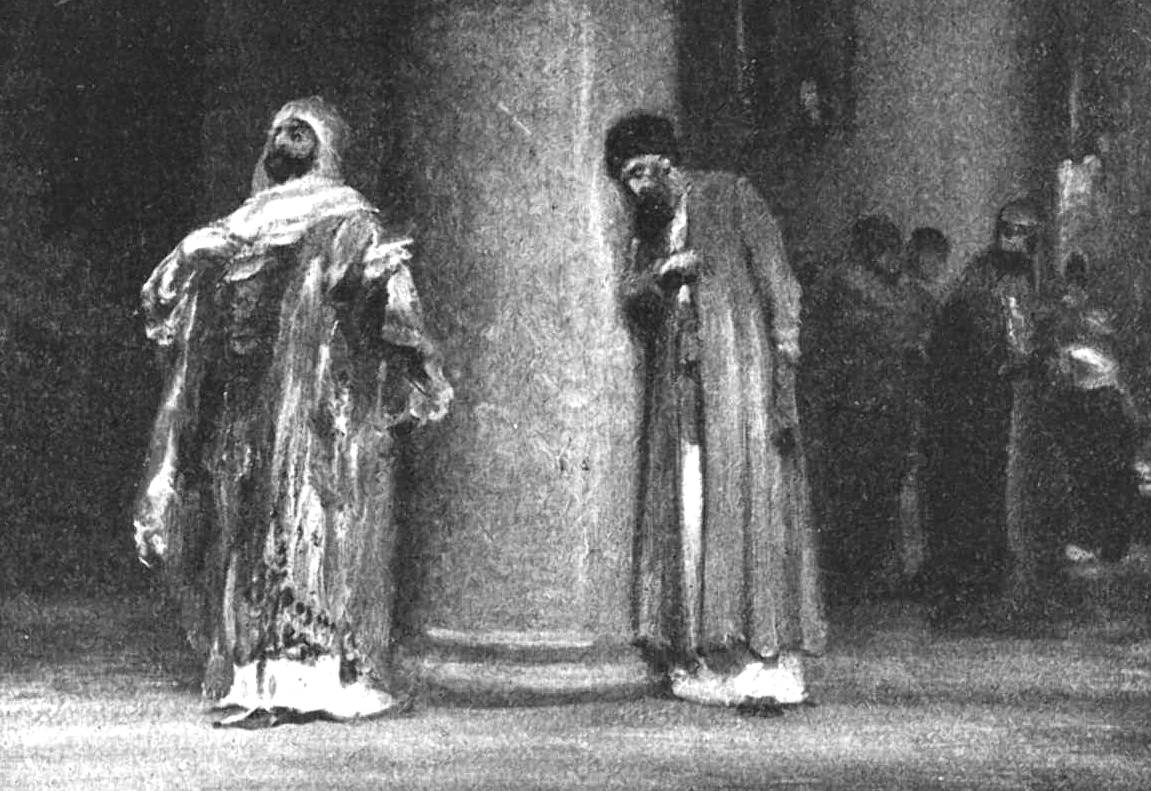
Pharisees were a group of Jewish believers that were extremely pious believers who closely followed and study and followed the law (Torah.) Not only this but in addition to the written law they followed what an ancient Jewish historian named Josephus called “the tradition of their fathers” or as Mark 7:5 describes the “tradition of the elders.” This tradition seemed to add extra, more strict regulations to the law to help the Pharisees in their individual pursuit of holiness. The name 'Pharisee' most likely means “one who is separate” but it is not known whether this is a name they were called negatively or a name they called themselves and embraced positively. In this parable however, it is clear that the Pharisee perceived himself to be ‘separate’ positively-  considering himself to be righteous whilst holding others with contempt. Jesus critiques this view and instead the Pharisee stands out as “one who is separate” in a negative way.

Pharisees occur frequently in the gospels- more often than not in opposition and antagonistic towards Jesus and his teachings. Jesus frequently condemned them for their lack of humility, compassion and the hypocrisy and arrogance that seemed to be characteristic of the movement. Luke’s gospel presents them as self promoting and obsessed with self-righteous acts. Yet they held a deep respect for the law and being faithful to God. Rejoicing and participating in the law was not a bad thing and the NT does not always interpret the Pharisees negatively.  It is worth mention that generally, the Pharisees were staunchly anti-Roman and part of their obedience was in hope that God would provide a saviour to rid and free them from the Roman Empire. Tax Collectors worked for the Roman Empire and these tensions and beliefs sit behind the parable.


The Tax Collector

Tax Collectors had the job of collecting revenue for the Roman government. Most often there were private contractors that were required to pay a set fee back to the Roman government but were able to keep anything over the fixed amount as commission. As you can imagine, this led to a large amount of corruption and abuse. To make things worse, the contracts for tax collector were often given to wealthy foreigners. Often they picked on poorer farmers trying to sell or move goods to the markets. Needless to say they were not popular in first century Palestine. The Pharisees held them with such little regard they considered them unclean through there contact with gentiles. Often these negative views come across through the pairing of sinners with tax collectors (almost as if these words were synonymous) i.e. Luke 15:1, Matt 11:19, and Matt 9:11- “  When the Pharisees saw this, they said to his disciples, “Why does your teacher eat with tax collectors and sinners?”

The Story

Audience
The introduction tells us that Jesus told this parable to “some who were confident of their own righteousness and looked down on everybody else.” Who is this audience? We don’t know.  The temptation would be to try and fill in the gaps and presume it was some exceptionally bad and hypocritical people (maybe some Pharisees). But who is to say he is not addressing the disciples? Who is to say it is not Jesus’ own followers that trust in themselves and despise others? We as readers, should not be tempted to exclude ourselves as being the audience Jesus in addressing here (Joel Green mentions this). Either way, the introduction makes clear that Jesus is about to make a connection and parallel the behavior and character of the audience and the Pharisee.

Where do I stand?
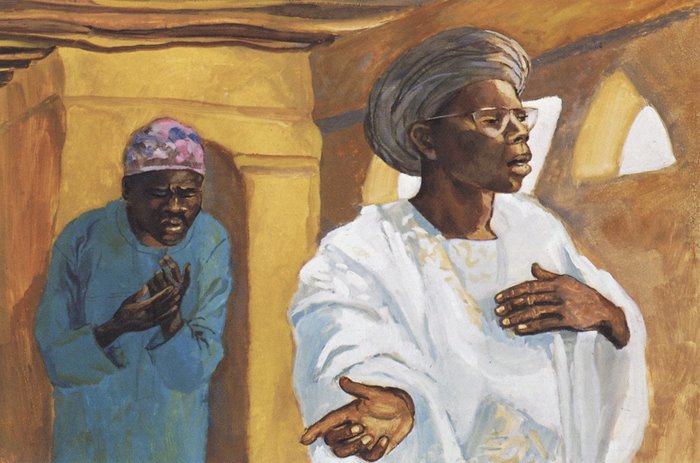
The Pharisee is described and being “by himself” while the tax collector is described as being “far off”.  The Pharisee is probably by himself because he considers others, and the tax collector to be unclean. To me though, it goes a bit deeper than that. He is also “by himself” in the sense he is reliant only on himself, and no one else. The Tax Collector however, is “far off”. This shows his reverence, humility and humbleness. He recognizes his short comings and takes responsibility. The attitude of the Tax Collector from the start is not to judge others or prove/justify himself in front of God.
The fact that the Pharisee notes he is glad he is not like the Tax Collector is actually his undoing. The parable illustrates that it is the tax collector who is justified. The Pharisee doesn't need to be condemned, because he has done that himself in his admission that he thanks God he is not like the tax collector.Additionally, Bailey notes he was probably praying aloud as per Jewish custom. He comments on this

Such a voiced prayer would provide a golden opportunity to offer some unsolicited ethical advice to the “unrighteous” around him who might not have another opportunity to observe a man of his stratospheric piety! Most of us in our spiritual journeys have, at some time or other, listened to a sermon hidden in prayer.


It is, without a doubt, a ‘loaded’ prayer with a focus on himself (note the repetition of ‘I’ in his prayer.) Whether it should even be considered a prayer is up for debate. What is certain is that his prayer lowers others and lifts himself up. But what Christ teaches is that we lower ourselves and lift others up. I really think the Tax Collectors prayer speaks for itself. There is no confusion as to what is going on (except maybe the beating on the chest which was an ancient form of mourning that you see often in the OT). The Tax Collector is simply humble, transparent, and genuine, and for that is justified because “For everyone who exalts himself will be humbles, and he who humbles himself will be exalted“.